


Procurement Solar Panels and Solar System Equipment
With the growing adoption of renewable energy and the increasing demand for sustainable power sources across industries, businesses, and various projects, solar energy has become one of the most important options for electricity generation. Among the key components of a photovoltaic (PV) system, solar panels play a central role in converting sunlight into electrical energy.
The rapid growth of the solar energy industry has created a global market covering a wide range of products and equipment, from solar panels and inverters to mounting structures, cables, connectors, protection devices, and energy storage systems.
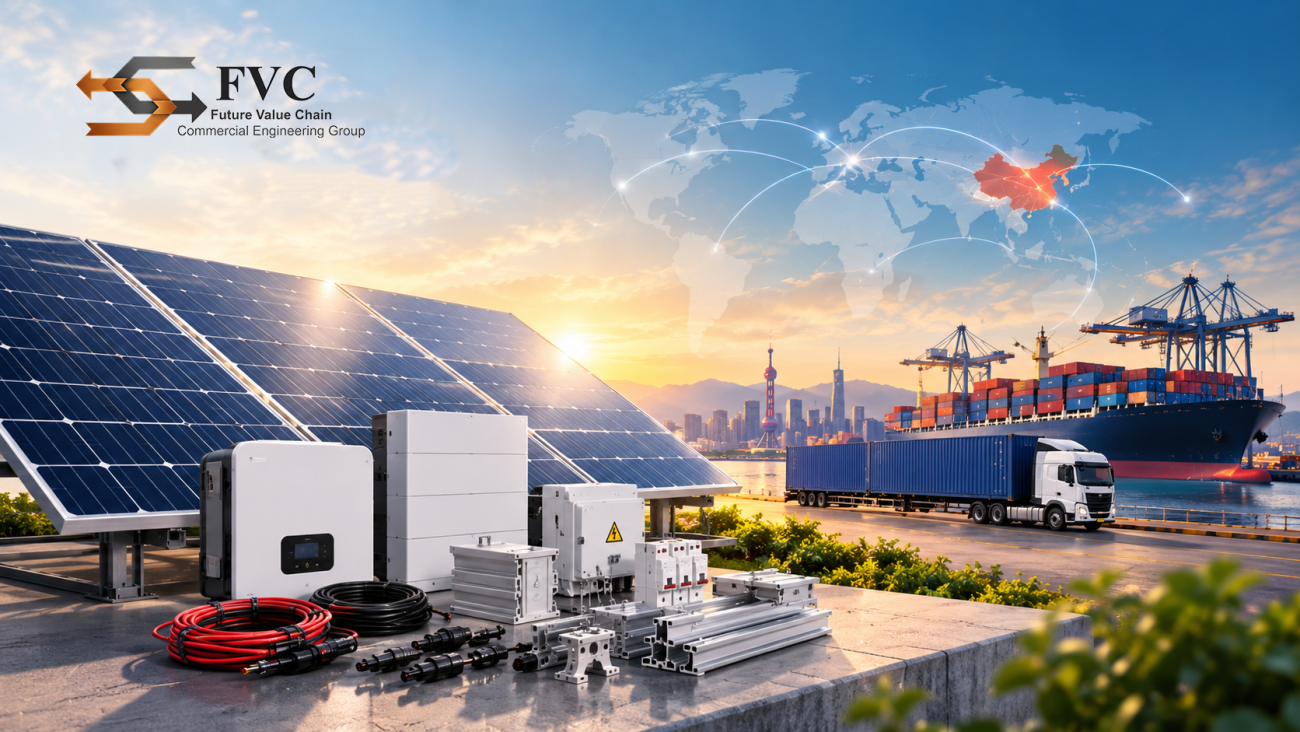
China is one of the world’s major manufacturing and supply centers for solar energy equipment. According to the International Energy Agency (IEA), China has a very significant share of global solar PV manufacturing capacity across different stages of the supply chain, from polysilicon and wafers to solar cells and modules.
For this reason, importing solar panels from China can be an important sourcing option for projects looking to access a wide range of products and manufacturers.
What Is a Solar Panel?
A solar panel, also known as a photovoltaic (PV) module, consists of multiple photovoltaic cells that convert sunlight into electrical energy. Most commonly available solar panels are manufactured using crystalline silicon solar cells.
When sunlight reaches the solar cells, an electrical current is generated through the photovoltaic effect. This electricity is then managed by the system’s electrical equipment and can be used directly, supplied to the grid, or stored for later use.
A solar panel alone does not constitute a complete electricity-generation system. Depending on the application, additional equipment is generally required to build a functional solar power system.
Main Components of a Solar Panel
A standard solar module consists of several layers and components, each serving a specific purpose.
1. Solar Cell
The solar cell is the main energy-generating component of a solar panel. Its primary function is to convert sunlight into electrical energy.
In crystalline silicon modules, solar cells are generally manufactured from silicon wafers and arranged in different configurations to form a solar module.
2. Protective Glass
The front surface of a solar panel is typically covered with durable glass. This layer protects the solar cells from environmental factors such as dust, moisture, precipitation, and mechanical impacts.
3. Encapsulant Layer
Solar cells are positioned between protective layers and encapsulant materials are used to protect the cells and provide proper bonding between the internal components.
EVA (Ethylene Vinyl Acetate) is one of the commonly used encapsulant materials in solar module manufacturing.
4. Backsheet or Rear Glass
Depending on the module design, the rear side may use a backsheet or glass. This layer protects the back of the solar cells and contributes to the electrical insulation, durability, and overall protection of the module.
5. Aluminum Frame
The aluminum frame provides mechanical strength to the solar module and facilitates installation and mounting.
6. Junction Box
The junction box is located on the back of the solar panel and provides the connection point for the panel’s electrical outputs. It may also contain protective components such as bypass diodes.
7. Cables and Connectors
Cables and connectors are used to connect solar panels to one another and to connect the panels to other electrical components within the solar power system.
According to the U.S. Department of Energy, the manufacturing process of a crystalline silicon module generally involves placing the glass, encapsulant layers, and solar cells, interconnecting the cells, laminating the module, installing the aluminum frame and junction box, and finally conducting electrical testing and inspection.
How Are Solar Panels Manufactured?
Solar panel manufacturing is a multi-stage process that begins with raw materials and ultimately results in a finished photovoltaic module.
In the crystalline silicon solar supply chain, the main stages include the production of polysilicon, ingots, wafers, solar cells, and modules.
The process can be simplified as follows:
Silicon → Polysilicon → Ingot → Wafer → Solar Cell → Solar Module
After the solar cells are manufactured, they are interconnected and positioned between protective layers. The complete assembly is then integrated through a lamination process, followed by the installation of the aluminum frame, junction box, and cables.
At the final stage, the finished solar modules undergo various electrical tests and quality-control procedures to verify their performance and specifications.
Equipment Required for Solar Energy Systems
Installing a solar energy system requires more than simply purchasing solar panels. Depending on the type of project, system capacity, and how the generated electricity will be used, different types of equipment may be required.
Solar Inverter
The inverter is one of the most important components of a photovoltaic system. Solar panels generate electricity in the form of direct current (DC), while the inverter converts it into alternating current (AC) suitable for many electrical loads or for connection to the power grid.
Solar inverters are available in several types, including:
String Inverters
Central Inverters
Microinverters
Hybrid Inverters
Inverters also represent an important part of the global solar equipment supply chain. According to IEA data, China accounted for approximately 80% of global manufacturing capacity for inverters used in solar and battery systems in 2025.
Solar Panel Mounting Structures
Solar panels require suitable mounting structures for installation on rooftops, ground-mounted projects, and other locations.
These structures may include:
Rooftop mounting systems
Ground-mounted structures
Fixed-tilt structures
Tracking systems
The appropriate mounting structure should be selected according to the installation site, environmental conditions, panel type, and overall project design. The U.S. Department of Energy also identifies mounting structures as an important component of PV systems.
Solar Cables and Connectors
Specialized photovoltaic cables are used to transmit electrical current between solar panels, junction boxes, and other system components.
PV connectors are also used to establish reliable electrical connections between solar modules and other equipment.
Protection Equipment and Electrical Panels
Depending on the system design, different protection devices may be required, including fuses, circuit breakers, overcurrent protection equipment, and Surge Protection Devices (SPDs).
Batteries and Energy Storage Systems
In solar systems equipped with energy storage, batteries are used to store generated electricity. Energy storage allows the stored power to be used when solar generation is insufficient, such as during periods of low sunlight or at night.
Importing Solar Panels and Solar Equipment from China
Selecting the right supplier is one of the most important stages in the process of importing solar equipment. Supplier selection is not limited to product price. Factors such as technical specifications, production capacity, product standards, manufacturer’s track record, contractual terms, quality control, packaging, and transportation are also important.
China is one of the world’s major hubs for the solar energy industry.
According to reports from the IEA, China holds a very large share of global PV manufacturing capacity across the solar supply chain, covering areas from raw materials and wafers to solar cells and modules. China also has significant manufacturing capacity for related equipment, including solar inverters.
This extensive manufacturing base provides importers with access to a wide range of manufacturers and solar energy products.
Our Solar Panel Import and Sourcing Services
With 12 years of experience in import activities, our company has the experience and infrastructure required to manage various stages of sourcing and importing products from international markets.
In the solar energy sector, our services are not limited to importing solar panels. We can also support the sourcing and import of a wide range of products and equipment required for solar energy projects.
Solar Panel Sourcing and Import
One of our key services is the sourcing and import of solar panels based on specific project requirements.
Depending on the customer’s needs and project specifications, different options can be evaluated based on:
Panel power output
Solar cell technology
Dimensions and design
Module structure
Technical specifications
Application
Brand and manufacturer
Import of Solar System Accessories and Equipment
In addition to solar panels, our company can source and import various auxiliary components required for solar energy systems.
These products may include:
Solar Inverters
Hybrid Inverters
Mounting Structures
Solar Cables
PV Connectors
Junction Boxes
Protection Equipment
Energy Storage Systems
Batteries for Solar Energy Systems
Other project-specific solar equipment and accessories
This allows customers to manage the sourcing of multiple components through a single import and trading partner rather than searching separately for each piece of equipment.
The Advantage of Our Office and Supply Network in China
One of our key advantages is having an office in China and established commercial connections and a supply network in the country.
Having a local presence and direct connections within the Chinese market can facilitate the process of identifying manufacturers, communicating with suppliers, obtaining product information, reviewing purchasing conditions, and coordinating the sourcing process.
This is particularly important in the solar industry, where China has a large number of manufacturers and suppliers operating across different segments of the solar energy supply chain.
Instead of being limited to a single product or supplier, we can evaluate different options and identify products that are more closely aligned with the specific requirements of each project.
Solar Panel Sourcing and Import Process
The sourcing and import process for solar panels and equipment may vary depending on the project. However, the general process typically includes the following stages:
1. Understanding Customer Requirements
The project specifications, required capacity, intended application, and required equipment are first reviewed.
2. Identifying Suppliers
Based on the required specifications, suitable manufacturers and suppliers in the Chinese market are identified and evaluated.
3. Receiving and Comparing Quotations
Technical specifications, pricing, payment terms, production capacity, lead times, and other commercial conditions are reviewed and compared.
4. Specification and Quality Control
Before finalizing the purchase, the technical specifications and quality requirements of the products are reviewed. When necessary, product inspection can also be arranged.
5. Purchasing and Supplier Coordination
Once the product and commercial terms are approved, the order is placed and coordination with the manufacturer begins.
6. Transportation and Import
After the products are ready, arrangements related to packaging, transportation, commercial documentation, and the import process are coordinated.
7. Delivery
Finally, after completing the required import and customs clearance procedures, the goods are delivered to the customer according to the agreed terms.
Why Is China an Important Source for Solar Equipment?
Over the past several years, China’s solar industry has developed into an extensive industrial ecosystem. This supply chain includes raw materials, wafer manufacturing, solar cells, modules, inverters, and other solar energy equipment.
The International Energy Agency has reported that China has accounted for more than 80% of global solar module manufacturing capacity in recent years, while its share of wafer manufacturing capacity has been even higher.
In addition, approximately 80% of global manufacturing capacity for inverters used in solar and energy storage systems was located in China in 2025.
These conditions have made China one of the world’s major sourcing centers for solar panels and related equipment.
Solar Panel Import: From Product Selection to Delivery
Importing solar panels involves much more than purchasing a product from an overseas factory. Selecting the right supplier, reviewing technical specifications, conducting quality control, negotiating commercial terms, coordinating transportation, and managing import procedures all play an important role in the overall sourcing process.
With 12 years of experience in import operations, combined with our office and commercial network in China, our company provides sourcing and import solutions for solar panels and a wide range of related equipment.
Based on each customer’s requirements, we can manage the sourcing process for solar panels and related equipment from the Chinese market and coordinate the necessary purchasing and import procedures.
If you are looking for solar panel imports from China, solar inverters, mounting structures, solar cables, PV connectors, protection equipment, or other solar system components, you can share your project specifications and requirements with our experts so that suitable sourcing and import options can be evaluated.
Conclusion
Solar energy is one of the most important sectors of the renewable energy industry. Solar panels, as the core component of photovoltaic systems, work together with equipment such as inverters, mounting structures, cables, protection devices, and energy storage systems to create a complete solution for generating and managing electrical energy.
Given China’s position in the global solar equipment manufacturing supply chain, the country has become one of the world’s major sources for solar panels and equipment required for solar energy projects.
With 12 years of experience in import operations, an office in China, and an established commercial and sourcing network in the country, our company provides sourcing and import solutions for solar panels and a wide range of related solar equipment.
Our goal is to provide a reliable and professional route for sourcing, purchasing, and importing solar equipment from China, helping customers access products that meet their specific project requirements.